Being diagnosed with a heart blockage often creates immediate uncertainty for patients and their families, primarily because the term describes several distinct cardiovascular conditions. In clinical cardiology, a blockage can mean a physical narrowing of the arteries that feed oxygen to the heart muscle (Coronary Artery Disease), a microscopic constriction of the tiny vessels within the heart wall (Microvascular Angina), or an interruption in the electrical wiring that triggers each heartbeat (Atrioventricular Conduction Block). Because each type of blockage stems from a different physiological mechanism, effective treatment requires pinpointing the exact anatomical defect before choosing between targeted medication, wrist-access stenting, pacemaker therapy, or open-heart bypass surgery.
Across Patna and Bihar, clinicians are diagnosing coronary artery blockages at increasingly younger ages, frequently affecting adults in their thirties and forties. Uncontrolled Type 2 diabetes, chronic hypertension, elevated low-density lipoprotein (LDL) cholesterol, tobacco consumption, and sedentary work routines accelerate plaque deposition inside the coronary vessels. Modern heart blockage treatment focuses not only on reopening obstructed arteries during an emergency, but also on utilizing high-resolution intravascular cameras to place stents with precision and protecting the digestive tract from blood-thinner complications.
In strict compliance with the National Medical Commission (NMC) guidelines for factual, transparent, and non-promotional medical education, this comprehensive guide explains the pathology of heart blockages, how clinical severity dictates treatment, and how the Ford Hospital network delivers specialized care across three integrated facilities in Patna.
To understand how cardiologists treat a heart blockage, it helps to examine how the heart’s vascular supply and electrical pathways function independently.
Three major epicardial arteries—the Left Anterior Descending (LAD), the Left Circumflex (LCX), and the Right Coronary Artery (RCA), branching from the Left Main trunk—supply oxygenated blood to the pumping myocardium. Over time, high blood sugar, high blood pressure, and circulating LDL cholesterol damage the delicate inner lining (endothelium) of these vessels. Lipids, inflammatory cells, and calcium accumulate inside the vessel wall to form atherosclerotic plaque.
Clinicians categorize arterial plaque into two structural types that behave very differently:
Some patients experience classic exertional chest pain and have an abnormal stress test, yet their main coronary arteries appear clear on an angiogram. In these cases, the blockage lies in the microscopic arterioles (microvasculature) that fail to dilate properly during exertion—a condition commonly seen in women and patients with long-standing diabetes or hypertension.
In an electrical heart block, the blood vessels may be unobstructed, but the electrical signal travelling from the upper chambers (atria) to the lower pumping chambers (ventricles) is delayed or severed at the Atrioventricular (AV) node. While a mild First-Degree Block only needs observation, a Complete Heart Block (Third-Degree AV Block) causes the pulse rate to drop below 35 to 40 beats per minute, requiring a Permanent Pacemaker rather than an angioplasty stent.
Coronary narrowings under 50% rarely restrict resting blood flow, meaning early blockages often develop silently for years. Symptoms emerge when physical exertion or emotional stress raises the heart’s oxygen requirement beyond what the narrowed artery can supply:
Finding a blockage on a diagnostic test does not automatically mean a patient requires surgery or stenting. Cardiologists follow standardized international and Indian clinical guidelines to match the anatomical finding to the least invasive, most durable therapy:
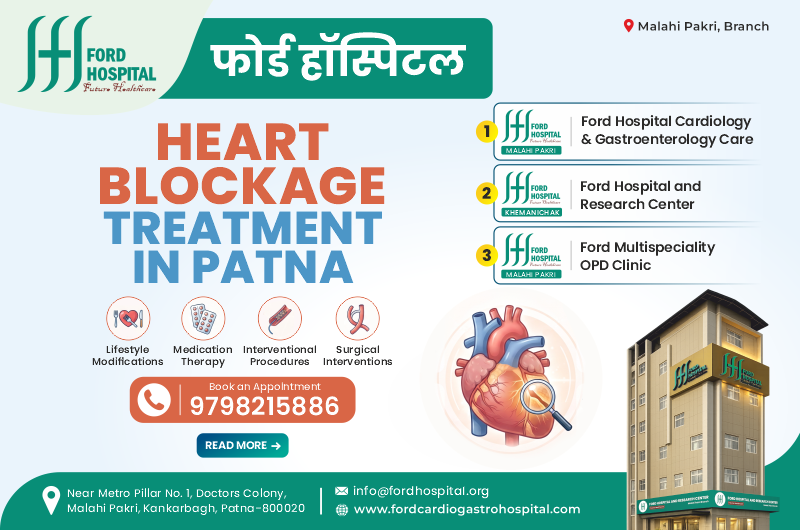
Treating heart blockages effectively requires aligning the right clinical environment with the patient’s stage of disease. Within the Ford Hospital network, care is organized sequentially across three specialized facilities in Patna: led by our dedicated interventional cardiology and gastroenterology institute, backed by our flagship 24×7 cardiothoracic surgical and multispeciality emergency hospital, and supported by our daytime outpatient diagnostic clinic.
Located centrally at Malahi Pakri, Kankarbagh, Patna, Ford Hospital Cardiology & Gastroenterology Care serves as our primary specialized center for catheter-based heart blockage treatment, intracoronary imaging, cardiac rhythm devices, and the clinical co-management of intersecting heart and digestive disorders.
Most patients requiring interventional treatment for single-vessel or double-vessel coronary blockages—or electrical conduction blocks—benefit from minimally invasive transcatheter procedures that avoid open chest incisions. At this institute, our interventional cardiologists prioritize the Radial-First approach, performing coronary angiography and angioplasty through the small radial artery in the wrist rather than the groin. Wrist access lowers vascular bleeding risks, minimizes post-procedure bed rest, and allows stable patients to sit up and walk within hours.
To ensure stents are placed with microscopic accuracy, the institute’s Digital Cath Lab integrates advanced physiological and imaging modalities:
Explore Our Dedicated Core Services at Kankarbagh:
Located near New Bypass (NH-30), Khemnichak, Patna, Ford Hospital & Research Center functions as our flagship 105-bedded multispeciality inpatient, emergency, and cardiothoracic surgical campus. When a coronary blockage presents as a massive acute heart attack with cardiogenic shock, involves complex triple-vessel or left main anatomy requiring open-heart bypass surgery, or occurs in a patient with concurrent kidney failure or stroke risks, this tertiary campus provides full surgical and multi-organ intensive care support.
During an acute heart attack (STEMI), a ruptured plaque and blood clot completely seal off a coronary artery. Our 24×7 emergency department executes rapid Golden Hour protocols supported by Advanced Life Support (ALS) ambulances, bedside ECG and High-Sensitivity Troponin testing, and direct activation of our on-site flat-panel Digital Cath Lab for emergency Primary Angioplasty.
When diagnostic angiography reveals extensive multi-vessel blockages, heavily calcified chronic total occlusions, or accompanying heart valve disease where bypass surgery offers superior long-term survival over stenting, our modular Cardiothoracic & Vascular Surgery (CTVS) suites perform Beating-Heart (Off-Pump) CABG. By stabilizing only the target segment of the coronary artery while the heart continues beating naturally, off-pump bypass reduces systemic inflammation and kidney strain in elderly and diabetic patients. Post-surgical and critically ill cardiac patients recover in high-dependency Intensive Coronary Care Units (ICCU) equipped with Intra-Aortic Balloon Pumps (IABP), mechanical ventilators, and 24×7 bedside dialysis.
To protect complex blockage patients who suffer from overlapping systemic illnesses, the main campus integrates 20 inpatient and surgical departments:
Not every heart blockage requires an inpatient admission; mild-to-moderate coronary plaque (under 50% narrowing), microvascular angina, and post-stent or post-bypass maintenance are managed on an outpatient basis. The Ford Multispeciality OPD Clinic provides a calm, streamlined daytime outpatient environment currently offering specialized OPD consultations across Cardiology, Gastroenterology, Gynecology, Psychiatry, General & Laparoscopic Surgery, Internal Medicine, and Diabetes/Endocrinology.
Patients visiting the OPD clinic with exertional fatigue, borderline chest heaviness, or a strong family history of heart disease undergo structured non-invasive testing—including resting 12-lead ECGs, 2D Color Doppler Echocardiography (to measure Left Ventricular Ejection Fraction and detect wall motion abnormalities), and Treadmill Stress Testing (TMT) to check for inducible ischemia under exercise. For patients managing stable blockages medically or recovering after angioplasty or CABG, cardiologists titrate anti-anginal medications (beta-blockers, calcium channel blockers, and metabolic modulators like trimetazidine or ranolazine), adjust statins to keep LDL cholesterol below 55 mg/dL, and coordinate diabetic and nutritional care.
Outpatient Specialty Directory at Ford Multispeciality OPD Clinic:
To help patients and family members select the right branch based on their symptoms and required procedure, the table below compares our three cardiovascular centers:
| Clinical Parameter | #1 Ford Cardiology & Gastro Care | #2 Ford Hospital & Research Center | #3 Ford Multispeciality OPD Clinic |
| Primary Role | Interventional Cardiology & Gastro Institute | 24×7 Emergency, ICCU & CTVS Bypass Campus | Dedicated Daytime Outpatient (OPD) Clinic |
| Location | Malahi Pakri, Kankarbagh, Patna | New Bypass, Khemnichak, Patna | Patna Outpatient Center |
| Target Blockage | Single/Double Vessel, Stenting & Heart Block | Acute Heart Attack, Triple-Vessel & Left Main | Mild Plaque (under 50%) & Stable Angina |
| Diagnostic Tools | Radial Cath Lab, FFR, IVUS, OCT & Endoscopy | 24×7 ECG/Troponin, Digital Cath Lab & CT | 12-Lead ECG, 2D Echo, TMT & Lipid Panels |
| Core Treatments | Complex PCI Stenting, Pacemaker, AICD & GI Care | Primary PCI, Beating-Heart CABG & Valve Surgery | Medical Therapy (GDMT), Diet & Cardiac Rehab |
How to Choose the Right Branch for Your Needs:
Safe, evidence-based treatment of coronary and electrical heart blockages relies on collaboration within a multidisciplinary Heart Team—where clinical cardiologists, interventional specialists, and cardiothoracic surgeons review complex angiograms together. In accordance with NMC guidelines regarding transparent presentation of practitioner credentials, below is our cardiac specialist directory with direct consultation links:
1. Why is Ford Hospital Cardiology & Gastroenterology Care uniquely suited for patients undergoing coronary stenting?
Patients who undergo angioplasty and stenting for a heart blockage must take Dual Antiplatelet Therapy (blood thinners) for 6 to 12 months to prevent blood clots inside the stent. In patients with underlying gastritis or silent peptic ulcers, these mandatory blood thinners can trigger stomach pain or upper gastrointestinal bleeding. At Ford Hospital Cardiology & Gastroenterology Care (Kankarbagh), our interventional cardiologists (using FFR, IVUS, and OCT for precision stenting) practice alongside senior gastroenterologists under the same roof—ensuring immediate endoscopic stomach protection and accurate differentiation between cardiac angina and esophageal reflux.
2. Can a 75% to 90% chronic heart blockage be cleared with oral medicines alone without angioplasty?
Oral medications—including high-intensity statins, antiplatelets, beta-blockers, and ACE inhibitors—are essential for every cardiac patient because they stabilize soft cholesterol plaque, prevent fresh blood clots, and reduce the heart’s oxygen workload. However, tablets cannot chemically dissolve hardened fibro-calcific plaque that is already narrowing an artery by 75% to 90%. If a severe blockage continues to restrict blood flow and cause angina or ischemia despite medical therapy, mechanical revascularization via Drug-Eluting Stent (PCI) or bypass surgery (CABG) is required to restore normal circulation.
3. How do FFR, IVUS, and OCT prevent unnecessary stenting and improve stent lifespan?
A conventional coronary angiogram only shows a two-dimensional X-ray shadow of contrast dye inside the artery. FFR (Fractional Flow Reserve) measures the exact pressure drop across a borderline blockage (50% to 70%); if blood flow is not significantly reduced, the cardiologist safely avoids placing a stent. When a stent is needed, IVUS (Intravascular Ultrasound) and OCT (Optical Coherence Tomography) provide cross-sectional microscopic views from inside the artery—allowing the cardiologist to measure true vessel size, check calcium thickness, and expand the stent completely against the artery wall, which lowers the risk of future re-narrowing.
4. When is Beating-Heart CABG (Bypass Surgery) recommended over coronary angioplasty?
While single-vessel and double-vessel blockages are routinely treated with wrist-access angioplasty and stenting, Coronary Artery Bypass Grafting (CABG) at Ford Hospital & Research Center is generally recommended when blockages involve all three major coronary arteries (Triple-Vessel Disease), severely narrow the Left Main stem, or involve long, heavily calcified total occlusions—particularly in patients who also have Type 2 diabetes or reduced heart pumping function (low LVEF).
5. Is cashless hospitalization available for coronary angiography, IVUS/OCT stenting, pacemakers, and bypass surgery?
Yes. Both Ford Hospital Cardiology & Gastroenterology Care and Ford Hospital & Research Center maintain dedicated 24×7 Third-Party Administrator (TPA) and insurance coordination desks. We facilitate cashless hospitalization and procedural approvals for diagnostic angiography, FFR/IVUS/OCT-guided angioplasty, pacemaker/AICD implantation, and Beating-Heart CABG surgery under recognized private health insurance providers and eligible government healthcare schemes, subject to standard policy terms and verification.