When cholesterol and calcium deposits narrow the arteries supplying blood to the heart muscle, restoring circulation promptly is essential to relieve chest pain and prevent permanent heart muscle damage. Heart angioplasty—known medically as Percutaneous Coronary Intervention (PCI)—is a minimally invasive, non-surgical procedure that reopens obstructed coronary arteries from the inside. Using a slender catheter introduced through a small puncture in the wrist or groin, an interventional cardiologist guides a miniature medical balloon to the site of the blockage, inflates it to compress the atherosclerotic plaque, and implants a laser-cut metallic mesh scaffold called a Drug-Eluting Stent (DES) to keep the vessel open over the long term.
Across Patna and Bihar, clinicians are performing coronary angioplasty for an increasingly diverse patient population—ranging from adults in their late thirties and forties with premature diabetes-driven blockages to elderly patients with heavily calcified multi-vessel disease. Modern coronary angioplasty has evolved significantly beyond traditional two-dimensional X-ray stenting. Today, combining wrist-access catheterization with microscopic intravascular cameras and proactive gastrointestinal protection allows patients to undergo stenting with enhanced precision, rapid mobilization, and safer blood-thinner management.
In strict adherence to the National Medical Commission (NMC) guidelines for factual, transparent, and non-promotional medical education, this clinical guide explains when heart angioplasty is medically indicated, how modern stent technology and intravascular imaging work, and how the Ford Hospital network coordinates interventional, surgical, and outpatient cardiac care across three specialized facilities in Patna.
Discovering plaque on a heart scan does not automatically mean a patient needs a stent. Mild arterial narrowings (less than 50% obstruction) generally do not restrict resting or exercise blood flow and are managed safely with cholesterol-lowering and antiplatelet medications. Interventional cardiologists recommend coronary angioplasty only when a blockage physically starves the heart muscle of oxygen (myocardial ischemia) or threatens an acute heart attack.
Clinicians evaluate patients for emergency or planned heart angioplasty when the following warning symptoms and diagnostic thresholds are present:
Historically, coronary angioplasty relied entirely on flat, two-dimensional X-ray shadows of contrast dye injected through a groin catheter. While X-ray fluoroscopy shows the hollow channel (lumen) of the artery, it cannot see inside the arterial wall itself—where calcium depth, plaque composition, and true vessel diameter determine how well a stent will expand. Modern interventional cardiology overcomes these limitations through four clinical advancements:
Rather than puncturing the deep femoral artery in the groin—which requires 6 to 8 hours of strict flat bed rest and carries a higher risk of local bruising—interventional cardiologists access the small radial artery in the wrist under local anesthesia. Because the radial artery is superficial and easily compressed with a lightweight wrist band, bleeding complications are markedly reduced, and stable patients can sit up immediately after leaving the Cath Lab.
When an angiogram shows a borderline blockage between 50% and 69%, visual estimation alone can lead to either unnecessary stenting or missed ischemia. Passing an ultra-thin FFR pressure-sensor wire across the narrowing measures the exact blood pressure ratio before and after the plaque. If the FFR score is above 0.80, stenting is safely deferred in favor of medication; if it is 0.80 or below, targeted stent placement restores normal myocardial perfusion.
To ensure a stent lasts for decades without re-narrowing (in-stent restenosis), the stent must be sized accurately to the vessel wall and expanded completely. IVUS uses high-frequency sound waves from the tip of a miniature catheter to measure the exact external elastic membrane diameter of the artery and penetrate deep tissue layers. OCT uses near-infrared light to generate microscopic cross-sectional images with 10 times the resolution of ultrasound—allowing the cardiologist to spot thin-cap ruptures, measure calcium thickness, select the exact millimeter length and diameter of the stent, and verify after inflation that every metallic strut is pressed flush against the vessel wall.
Early bare-metal stents occasionally developed internal scar tissue overgrowth within 6 to 12 months. Modern third-generation Drug-Eluting Stents feature ultra-thin cobalt-chromium or platinum-chromium struts coated with a biocompatible polymer that slowly releases an anti-proliferative medication (such as everolimus, zotarolimus, or sirolimus) over 30 to 90 days. This controlled medication release prevents excessive scar tissue formation while allowing the body’s natural endothelial cells to smoothly cover the stent struts.
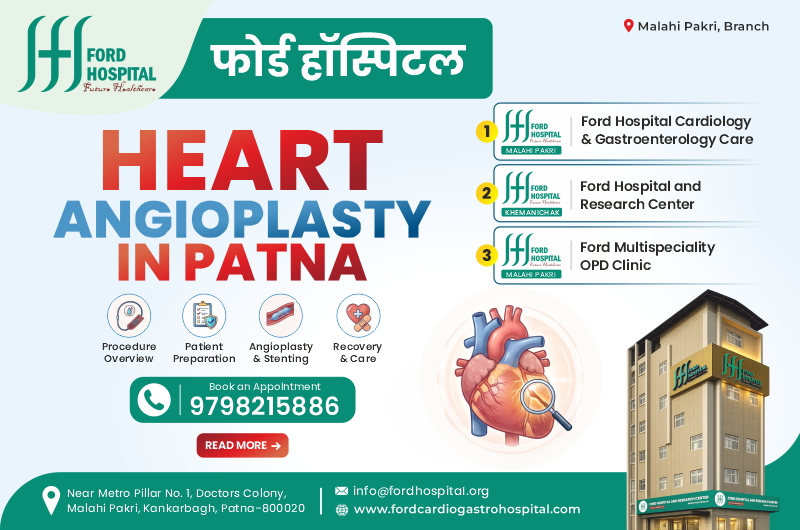
Safe, successful coronary angioplasty requires more than just a catheterization suite; it requires co-management of post-stent blood thinners, 24×7 cardiothoracic surgical and multi-organ ICU backup for complex cases, and structured outpatient follow-up. Within the Ford Hospital network, care is organized sequentially across three specialized facilities in Patna:
Located centrally at Malahi Pakri, Kankarbagh, Patna, Ford Hospital Cardiology & Gastroenterology Care serves as our primary specialized center for elective and emergency transradial coronary angioplasty, intracoronary imaging, cardiac device implantation, and the clinical co-management of intersecting heart and digestive disorders.
For patients undergoing single-vessel, double-vessel, or complex bifurcation stenting, this dual-specialty institute provides a focused cardiovascular environment equipped with a modern flat-panel Digital Cath Lab. Our interventional cardiologists prioritize “Radial-First” wrist-access PCI supported by FFR, IVUS, and OCT imaging—ensuring every Drug-Eluting Stent is deployed with millimetric precision. When myocardial ischemia is accompanied by electrical conduction blocks or weakened ventricular pumping, the institute also performs implantations of Permanent Pacemakers, Automated Implantable Cardioverter-Defibrillators (AICDs), and Cardiac Resynchronization Therapy (CRT-P / CRT-D) devices.
A major clinical reason patients choose this specialized institute for heart angioplasty is The Cardio-Gastric Safety Protocol. Every patient who receives a coronary stent must take Dual Antiplatelet Therapy (DAPT—Aspirin combined with Clopidogrel, Prasugrel, or Ticagrelor) for 6 to 12 months to prevent a blood clot from forming inside the stent (stent thrombosis). However, dual blood thinners can irritate the stomach lining and provoke upper gastrointestinal bleeding in patients with underlying H. pylori gastritis, acid reflux, or silent peptic ulcers. If a patient stops their blood thinners abruptly due to stomach bleeding, the heart stent can clot within hours. By housing senior interventional cardiologists and gastroenterologists under the exact same roof, patients at our Kankarbagh center receive proactive gastro-protective therapy and, if bleeding ever occurs, immediate therapeutic endoscopy (such as endoscopic hemoclipping) to stop gastric bleeding while keeping the heart stent safely protected.
Explore Our Dedicated Core Services at Kankarbagh:
Located near New Bypass (NH-30), Khemnichak, Patna, Ford Hospital & Research Center functions as our flagship 105-bedded multispeciality inpatient, emergency, and cardiothoracic surgical campus. When an angioplasty involves high-risk multi-organ complexities—such as an acute heart attack complicated by cardiogenic shock, severe chronic kidney disease, or borderline triple-vessel anatomy that may require open-heart surgical standby—this tertiary hospital provides complete 20-department clinical backup under one roof.
During an acute heart attack, our 24×7 emergency trauma bay and Advanced Life Support (ALS) ambulances execute rapid Door-to-Balloon protocols, transferring patients directly to the on-site flat-panel Digital Cath Lab for emergency Primary Angioplasty (Primary PCI). Patients with severely weakened heart pumping (LVEF less than 30% to 35%) or hemodynamic instability are supported in our Intensive Coronary Care Unit (ICCU) with Intra-Aortic Balloon Pump (IABP) counterpulsation, mechanical ventilation, and invasive arterial monitoring.
Furthermore, two critical patient groups benefit directly from the main campus’s multispeciality infrastructure:
Complete 20-Department Multispeciality Directory at Ford Hospital & Research Center:
A coronary stent clears the mechanical bottleneck inside the treated artery, but keeping that stent open—and preventing new blockages from forming in untreated vessels—requires structured outpatient medical management before and after the procedure. The Ford Multispeciality OPD Clinic provides a calm, crowd-free daytime outpatient environment currently delivering specialized OPD consultations across Cardiology, Gastroenterology, Gynecology, Psychiatry, General & Laparoscopic Surgery, Internal Medicine, and Diabetes/Endocrinology.
Before an elective angioplasty is ever planned, patients visit the OPD clinic for non-invasive functional screening—including resting 12-lead ECGs, 2D Color Doppler Echocardiography (to evaluate Ejection Fraction and chamber wall motion), and Treadmill Stress Testing (TMT)—to verify whether invasive catheterization is needed. Following discharge after an angioplasty at our Kankarbagh or Khemnichak hospitals, patients return to the OPD clinic at scheduled intervals (Day 7, Month 1, Month 3, Month 6, and Month 12) for radial wrist-site checks, Dual Antiplatelet Therapy (DAPT) monitoring, high-intensity statin titration to drive LDL cholesterol below 55 mg/dL, strict HbA1c control, and supervised Phase-2 outpatient cardiac rehabilitation.
Outpatient Specialty Directory at Ford Multispeciality OPD Clinic:
To help patients and family members select the appropriate Ford Hospital facility for pre-procedure screening, coronary stenting, or complex surgical backup, review the comparison table below:
| Clinical Parameter | #1 Ford Cardiology & Gastro Care | #2 Ford Hospital & Research Center | #3 Ford Multispeciality OPD Clinic |
| Facility Role | Radial Stenting & Cardio-Gastric Hub | 24×7 Emergency PCI, ICCU & CTVS Campus | Pre-PCI Screening & Post-Stent OPD |
| Location | Malahi Pakri, Kankarbagh, Patna | New Bypass, Khemnichak, Patna | Patna Outpatient Center |
| Primary Focus | Image-guided PCI, Pacemakers & GI safety | STEMI Primary PCI, CABG & Cardiorenal ICU | Non-invasive tests & lifelong DAPT rehab |
| Cath Lab & Tools | Radial Cath Lab, FFR, IVUS, OCT & Endoscopy | 24×7 Digital Cath Lab, IABP & CTVS OTs | 12-Lead ECG, 2D Echo, TMT & Lipid Labs |
| Support Scope | 24×7 CCU, Rhythm Devices & GI Hemostasis | 20 Departments, Bypass Standby & Dialysis | Daytime OPD across 7 Core Specialties |
How to Select the Right Facility for Your Stage of Care:
Long-term stent durability and procedural safety depend on the expertise of the interventional cardiologist performing the catheterization and the collaborative support of clinical cardiologists and cardiothoracic surgeons. In strict compliance with NMC ethical guidelines regarding transparent presentation of medical qualifications, below is our cardiac specialist directory with direct consultation links:
Understanding what happens in the hours, weeks, and months following Drug-Eluting Stent placement empowers patients and caregivers to protect the newly opened artery and return safely to normal life:
1. Why is co-managing Cardiology and Gastroenterology important during and after Heart Angioplasty?
After a Drug-Eluting Stent is placed during heart angioplasty, taking Dual Antiplatelet Therapy (two blood thinners) every day is mandatory to prevent a sudden clot inside the stent. In patients who have acid reflux, gastritis, or silent stomach ulcers, blood thinners can trigger gastric erosions or internal upper GI bleeding. At Ford Hospital Cardiology & Gastroenterology Care (Kankarbagh), our interventional cardiologists and gastroenterologists work under one roof—prescribing tailored gastro-protective regimens and performing immediate endoscopic treatment if bleeding ever arises, ensuring your heart stent medications are never dangerously interrupted.
2. How do IVUS and OCT imaging improve the success of a heart angioplasty compared to a standard X-ray angiogram?
A standard X-ray angiogram shows only a flat two-dimensional shadow of contrast dye flowing through the artery. IVUS (Intravascular Ultrasound) and OCT (Optical Coherence Tomography) pass a microscopic imaging sensor directly inside the coronary artery. This allows the cardiologist to measure the exact millimeter diameter of the vessel, check whether heavy calcium needs specialized plaque preparation before stenting, and confirm after balloon inflation that the stent is expanded completely against the artery wall—significantly reducing the risk of future re-narrowing (restenosis) or stent clotting.
3. Can a patient undergo Coronary Angiography and Heart Angioplasty in the same sitting?
Yes. This is called Ad-Hoc PCI (Same-Sitting Angioplasty). When a patient undergoes a 15-minute diagnostic transradial angiogram and a critical, flow-limiting blockage (70% or greater) is identified in one or two accessible arteries, the interventional cardiologist shows the digital angiogram to the family immediately. With informed consent, the stent can be placed right away through the exact same wrist tube—saving the patient a second hospital visit, a second wrist puncture, and extra contrast dye exposure.
4. What happens if an angiogram shows blockages that are too complex or calcified for angioplasty stenting?
If diagnostic angiography reveals diffuse blockages across all three major coronary arteries (Triple-Vessel Disease) or severe narrowing of the Left Main trunk—particularly in diabetic patients or those with reduced heart pumping function—our multidisciplinary Heart Team reviews the films jointly. Because Ford Hospital & Research Center (Khemnichak) houses dedicated modular CTVS operating theaters alongside our Cath Labs, patients requiring Beating-Heart (Off-Pump) CABG Bypass Surgery receive seamless surgical care within the same hospital network.
5. Is cashless insurance and government healthcare scheme support available for Heart Angioplasty in Patna?
Yes. Both Ford Hospital Cardiology & Gastroenterology Care and Ford Hospital & Research Center maintain dedicated 24×7 Third-Party Administrator (TPA) and insurance helpdesks. We facilitate cashless hospitalization and procedural approvals for diagnostic angiography, emergency Primary PCI, FFR/IVUS/OCT-guided Drug-Eluting Stent implantations, and CABG bypass surgery under recognized public and private health insurance providers as well as eligible government healthcare schemes, subject to policy terms and verification.